
Route Planning and Optimization


Route Planning and Optimization Software
Routimo is route planning and optimization software for companies managing deliveries, distribution, and field operations. It automatically plans routes across multiple stops and vehicles, taking into account driver working hours, time windows, vehicle capacity, order priorities, fleet availability, and more.
Routimo streamlines transport and fleet management, making it easier to plan deliveries and stay on top of order execution. The result? Less time spent planning, fewer empty runs, and lower operating costs.
Routimo supports the entire route planning process — from route optimization and driver communication to performance analysis and reporting.
See how the driver app works
Route Planning and Optimization in Practice
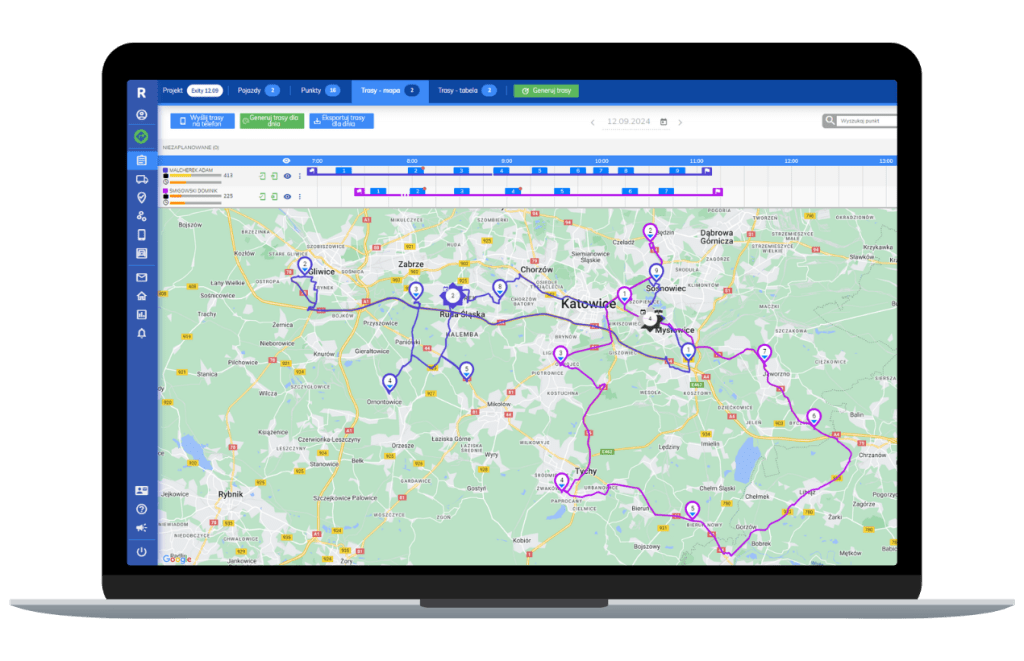
Route planning in Routimo starts with creating a project where you add your vehicles, drivers, and stops or orders. A project can cover a single day or any date range, giving you the flexibility to plan both daily deliveries and longer-term schedules.
How It Works
- Data Import & Mapping: Add vehicles and stops manually or import them from an Excel file. Column mapping automatically recognizes your data and assigns it to the right fields, helping you set up projects faster.
- Automatic Route Optimization: Once optimization starts, Routimo analyzes factors such as time windows, vehicle capacity, driver working hours, regions, and delivery priorities. It then automatically assigns stops to routes and determines the optimal stop sequence.
- Edit & Visualize on the Map: Review your optimized routes on an interactive map or in a table. Adjust the stop sequence, move orders between vehicles, or fine-tune the schedule before sending routes to your drivers.
Routimo is built for businesses that need to plan multiple deliveries, appointments, or jobs every day.
Learn More
Need a feature that’s not available yet? Contact us to explore custom development and tailored solutions with one of our experts.
- Avoiding toll roads and highways
- Start and end point
- Optimization goal
Industries We Serve
Businesses across industries face the same challenge: planning multiple deliveries, appointments, or jobs every day. Routimo helps keep operations running smoothly wherever efficient route planning and smarter fleet utilization matter.
No matter the size of your fleet, Routimo cuts route planning time, reduces costs, simplifies daily operations, and helps you complete more jobs with the resources you already have.
- Wholesalers and goods distribution
- E-commerce
- Field Service and Installation
- Medical and Passenger Transport
- Meal Prep Delivery
- Waste management and municipal services
- Courier companies and local deliveries
When Is manual route planning no longer enough?
When you only have a few delivery stops, planning routes manually may be enough. But as your fleet grows, order volumes increase, and plans change more frequently, scheduling takes more time and finding the most efficient stop sequence becomes increasingly difficult.
Manual Route Planning vs. Optimization with Routimo
Ręczne układanie tras
Long time and lack of organization
Planning routes in Excel and mapping tools takes more and more time as the number of delivery stops and vehicles grows.
Too many constraints to manage manually
Manual planning requires constant updates to travel times, stop sequences, and vehicle availability.
Slower response to changes
Sudden changes in the schedule make it difficult to quickly update routes and organize current deliveries.
Limited control over execution
Manual planning becomes less effective with a larger number of routes, vehicles, and daily orders.
Optymalizacja tras z Routimo
Automatic route determination
Routimo automatically determines the most efficient routes, shortening planning time and schedule updates.
Routes Adapted to Real-World Conditions.
The system takes into account time windows, vehicle availability, driver schedules, and transport restrictions, among other factors.
Faster schedule updates
Changes to routes and schedules can be implemented on an ongoing basis without rebuilding the entire delivery plan.
Managing multiple routes and vehicles
The system supports planning multiple routes, vehicles, and delivery points within a single schedule.
Automatic route planning for multiple points
Routimo automatically plans and optimizes routes based on current data about stops, vehicles, and project settings. The system analyzes multiple route options and selects the most efficient one based on travel time, distance, or transport costs. You can also define specific transport rules, such as
- avoiding highways,
- avoiding toll roads,
- balancing drivers’ working hours,
- utilizing all available vehicles.
These settings allow for better adaptation of route planning to fleet work organization and daily delivery conditions.
-
Speed
of planning
routes
Automation reduces route planners’ workload by up to 80% with intelligent algorithms that analyze stops, constraints, and delivery parameters.
-
Full control
and editing of
routes
After routes are generated, the planner can change the order of points, move tasks between vehicles, and re-optimize selected routes without having to create the plan from scratch.
-
Scalability
and adaptation
to business
The system can be adapted to various transport processes, from local deliveries to extensive operations involving multiple vehicles, regions, and order fulfillment schedules.
How does route optimization work in Routimo?
Routimo automatically determines optimal routes based on data about points, vehicles, and project settings. The system analyzes time windows, drivers’ working hours, delivery priorities, vehicle capacity, and logistical constraints, among other factors, to determine the most efficient order of task execution.
Optimization algorithms help reduce mileage, better utilize the fleet, and automate daily transport planning. After routes are generated, the user receives a ready travel plan with map visualization, the ability to further edit, and send routes to drivers.
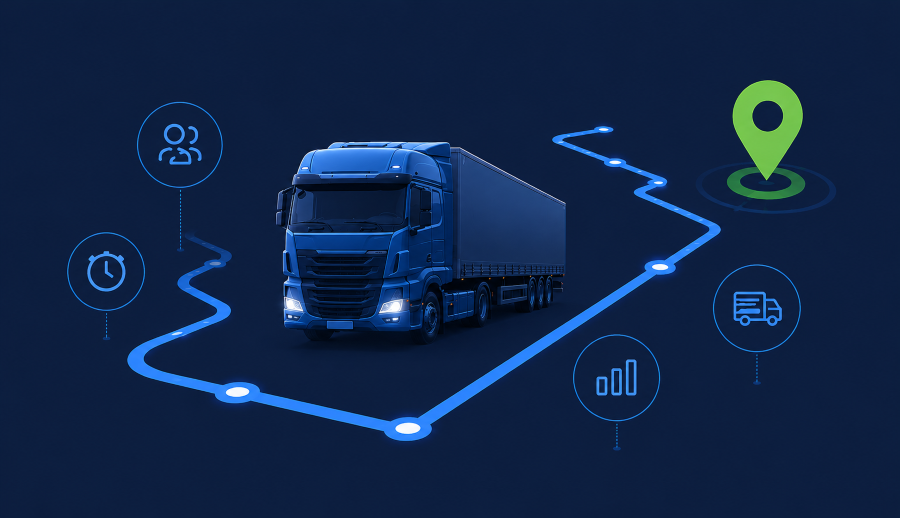
Intelligent route planning
- planning multiple vehicles simultaneously
- automatic point assignment
- optimal order of journeys
Routimo analyzes data on points, drivers, and project constraints, helping to create realistic and feasible route plans faster.
Optimization of transport costs
- reducing empty runs
- shorter travel distances
- better fleet utilization
Better route planning allows for a greater number of deliveries without increasing the fleet and reduces costs associated with fuel, drivers’ working hours, and inefficient vehicle utilization.
Monitoring and analysis of execution
- route preview on the map
- point fulfillment status
- ETA and delay analysis
- editing and updating routes
Constant monitoring of route execution facilitates reacting to delays, schedule changes, and unforeseen situations on the road.
FAQ – Frequently Asked Questions
In Routimo, the process begins with creating a so-called project, which can include one-day, weekly, or any future period routes. In one project, you can plan journeys for the entire vehicle fleet simultaneously. The process is intuitive:
-
Plan a project – you will name it and set the time frame.
-
Add vehicles – you will upload a list of vehicles with parameters such as working hours and payload.
-
Add points – you will import delivery addresses, which the system automatically maps.
-
Generate routes – the algorithm will analyze millions of combinations to determine the shortest and cheapest routes.
-
Map and edit – you can freely adjust the ready plan on an interactive map and send it directly to drivers’ mobile devices.
Want to learn more? See the guide to modern route optimization solutions »
For the system to generate a fully optimized transport plan, the following input data is required:
-
Points to serve – full address details, delivery time windows, and visit priorities.
-
Vehicle fleet – vehicle name, start and end location, working hours, and capacity/payload.
-
Operational parameters – required driver breaks, tonnage restrictions, and optimization goal (e.g., cost minimization or shortest distance).
-
Source files – you can instantly upload data from CSV/XLSX files thanks to the intelligent column mapping function. The more accurate the data about your logistics, the greater the savings the planner will generate.
.
The more accurate the data, the better the results – lower costs and shorter travel time. Also check how to choose good route planning software » and common route planning mistakes and how to avoid them »
Yes. Routimo is a modern system that takes into account current road traffic (jams) when determining route variants. This ensures that travel times are realistic and the order of points is optimal relative to peak hours. Additionally, the “Traffic” module allows for avoiding disruptions in real-time. The system also respects tonnage and dimension restrictions, which is crucial for heavy transport.
You can read more about route planning and modern tools in the route optimization guide » and Compact Gaz case study ».
Automatic route planning is a process that takes seconds, eliminates human errors, and shortens distances by an average of 20%. The algorithm analyzes constraints that a dispatcher cannot calculate. In turn, manual modification in Routimo gives you full control; at any time, you can change the order of points, move a task between drivers, or add a delay. A combination of both methods yields good results: the system generates an optimal proposal, and the dispatcher adjusts it to the specific needs of the day.
You can read more about how to adapt tools to your needs in the article How to choose good route planning and optimization software ».
The Routimo route optimization program is universal, but we observe the highest returns on investment (ROI) in the following industries:
-
Dietary catering (meal prep) – where precision in morning deliveries is crucial.
-
Wholesalers and FMCG distribution – when serving a dense network of pickup points.
-
E-commerce and courier companies – for last-mile deliveries.
-
Technical and assembly services – where planning client visits is key.
-
Waste management – for optimizing repetitive collection loops.
See how courier companies plan routes » and check out Case study: Compact Gaz – when route planning ceases to be a problem »
The Routimo route optimization program is universal, but we observe the highest returns on investment (ROI) in the following industries:
-
Dietary catering (meal prep) – where precision in morning deliveries is crucial.
-
Wholesalers and FMCG distribution – when serving a dense network of pickup points.
-
E-commerce and courier companies – for last-mile deliveries.
-
Technical and assembly services – where planning client visits is key.
-
Waste management – for optimizing repetitive collection loops.
See how courier companies plan routes » and check out Case study: Compact Gaz – when route planning ceases to be a problem »
Advanced route optimization eliminates the traveling salesman problem and supports effective transport and fleet management.
For just 5 vehicles and 20 delivery points, the system must analyze over 6 million possible route combinations. Manual planning will not account for all variables – such as delivery times, distances, or time windows. Therefore, intelligent route planning becomes crucial for logistics and transport companies.
Try Routimo Free for 7 Days
Save time and fuel – thanks to effective transport route optimization with Routimo.
Routimo AI-Powered Knowledge Center
Artificial intelligence helps quickly find information about Routimo features, route optimization settings, and best planning practices. The Routimo AI Assistant operates based on the GPT model.